Contents
This week, Formula 1 officially launched its 2026 Sim Racing World Championship at DreamHack Birmingham — and the scale of it is remarkable. Nine F1 teams. A $750,000 prize pool. An expected audience of 50,000+ fans at the opening event alone. And a brand-new, permanent sim racing facility being built at F1's own Media and Technology Centre.
This isn't a side project. This is Formula 1 — the world's most-watched motorsport — making a massive institutional bet on sim racing as a mainstream entertainment category.
For event marketers, trade show exhibitors, and corporate event planners, the implications are significant. The "niche gaming hobby" perception that once held some companies back from investing in racing simulator rentals for their events? That perception is officially dead.
The Big News: F1's Sim Racing Championship
Here's what F1 just announced: the 2026 F1 Sim Racing World Championship kicks off March 27–29 at the NEC in Birmingham as part of DreamHack's first-ever UK event. Nine teams — Alpine, Aston Martin, Ferrari, Haas, McLaren, Mercedes, Racing Bulls, Red Bull, and Williams — will field three-driver esports rosters competing across 12 rounds for a share of $750,000 in prize money.
After the Birmingham opener, remaining events move to F1's bespoke new sim racing facility in Biggin Hill — a permanent, purpose-built home for the championship. That's not a temporary setup or a pop-up installation. That's infrastructure investment.
For context, F1 has spent the last several years deliberately engineering cultural relevance — through the Netflix documentary series, through expanded social media, through younger audience engagement. Sim racing is the next logical pillar: it connects the physical sport to a massive digital audience that has grown up racing on screens.
The Numbers Behind the Explosion
The F1 announcement is the headline, but the underlying market data tells an equally compelling story about where sim racing is headed.
That's a nearly 4x market expansion over the next decade — growing at 16% annually while most entertainment categories grow at 3–5%. The hardware side is booming, but the experiential side — live sim racing events, corporate activations, trade show experiences — is growing even faster because it captures something hardware alone can't: the social thrill of racing against other people in a public setting.
Meanwhile, the demographics tell a powerful story for B2B marketers:
- Sim racing audiences skew 18–45 — the prime professional and decision-maker demographic at most trade shows and corporate events
- Strong crossover with automotive, technology, and financial services — three of the highest-spend verticals at trade shows
- Gender-balanced growth — newer sim racing titles and experiences have seen sustained growth among female participants, broadening the appeal beyond traditional "racing fan" demographics
- No prior racing knowledge required — anyone can pick up a wheel, step on the gas, and have a genuine, memorable experience within seconds
Why This Matters for Corporate Events
Here's the practical implication: when a cultural phenomenon reaches critical mass, brands that have already built familiarity with that phenomenon look prescient. Brands that adopt it late look reactive.
Sim racing is at that inflection point right now. Early-adopter companies have been using racing simulator rentals at trade shows and corporate events for several years — quietly generating 3–5x more leads than neighboring booths while building powerful brand associations with performance, innovation, and excitement. Now that F1 is making sim racing a household-name entertainment category, the general conference-going audience is going to understand and want the experience even more immediately.
Put simply: your booth visitors in 2026 are more primed for a racing simulator experience than they've ever been. The cultural context is doing the heavy lifting for you.
| Audience Segment | Pre-2026 Familiarity | Post-F1 Championship Familiarity | Impact on Your Booth |
|---|---|---|---|
| 18–35 professionals | High (gaming culture) | Very High | Immediate engagement, zero explanation needed |
| 35–50 executives | Moderate | High (F1 mainstream coverage) | Stronger curiosity, faster conversion to participation |
| Motorsport fans | Very High | Very High | Already motivated, seek you out specifically |
| Casual conference-goers | Low | Moderate–High | Mainstream awareness reduces hesitation to try |
The Bigger Experiential Marketing Shift
The F1 news doesn't exist in a vacuum. It's landing during a broader experiential marketing renaissance that's reshaping how top brands approach events. According to the latest industry research, the global experiential marketing market is growing from $55.53 billion in 2026 to a projected $71.22 billion by 2035 — and the trends driving that growth align almost perfectly with what racing simulators deliver.
1. The Digital Detox Effect
Audiences are craving physical, embodied experiences after years of screen-mediated interaction. Sim racing is unique in that it delivers a digital experience through physical engagement — you feel the wheel resistance, you lean into turns, you react with your hands and feet. It's active, not passive. This "physical digital" experience is exactly what event designers say audiences most want right now.
2. Micro-Experiences Are Winning
The biggest trend in 2026 booth design is the shift toward focused "micro-experiences" — demo pods, challenge stations, and content capture moments that create a defined, meaningful interaction rather than a broad, shallow one. A racing simulator is the textbook micro-experience: 3–5 minutes, complete immersion, a clear beginning and end, and a shareable result (your lap time on a public leaderboard).
3. Data-Driven Engagement Measurement
Modern event marketing demands ROI proof. Racing simulators are inherently measurable: you know exactly how many people raced, how long they engaged, and — when paired with a lead capture gate at registration — exactly who they are and how to follow up. This data-friendliness is increasingly rare among high-engagement activations.
4. Brand Storytelling Through Action
Research consistently shows that audiences remember experiences far more vividly than information. Giving a trade show visitor a 4-minute racing experience ties your brand to a specific memory — the adrenaline, the competition, the leaderboard. No brochure or screen demo creates that kind of memory anchor. The brands winning at experiential events in 2026 are the ones replacing information delivery with experience delivery.
Your 2026 Activation Action Plan
Given everything happening in the sim racing and experiential marketing landscapes, here's a practical framework for capitalizing on the moment:
Book Early — Demand Is Rising
The same cultural forces making sim racing more mainstream are driving up demand for quality simulator rentals. The best racing simulator rental setups — full-motion rigs, professional grade displays, operator-staffed experiences — book out months in advance for major trade shows. If you have Q2 or Q3 events on the calendar, now is the time to secure your equipment.
Align the Experience to Your Brand
Sim racing works for virtually any industry, but the strongest activations tie the racing experience directly to the brand story. A technology company can frame it around "performance at speed." A financial services firm can frame it around "precision under pressure." An automotive brand — obviously — can go full immersion. The racing is the draw; your brand narrative is the wrapper.
Build the Lead Capture Into the Experience
Don't let the experience stand alone. Every person who wants to race should register first — name, company, email, phone. The natural transaction (give us your info, get to race) is the most frictionless lead capture in the event marketing playbook. Pair this with a leaderboard prize or daily winner announcement to drive repeat visits and increase data collection.
Plan for Social Content
The F1 championship announcement generated global media coverage partly because sim racing produces naturally compelling visual content — action shots, intense facial expressions, leaderboard drama. Your event is no different. Have a camera set up to capture racers in action, create a branded hashtag, and encourage participants to share their lap times. A well-executed sim racing activation generates organic social media content that extends your reach far beyond the show floor.
Scale to Your Space
One simulator can handle 80–100 engaged visitors in an 8-hour show day. Two simulators create a competitive dynamic (head-to-head racing) that dramatically increases spectator interest. Three or more simulators turn your booth into an unmistakable destination. Match the scale to your booth size and lead volume targets — and know that the team at Velocity Pro Sims can help you right-size the setup for your specific event.
The Bottom Line
Formula 1's $750,000 sim racing championship is more than a sports headline. It's a cultural signal that reinforces what smart event marketers have already discovered: racing simulators are the single highest-ROI interactive activation available for trade shows and corporate events.
The market is growing at 16% annually. Audience familiarity is at an all-time high. Experiential marketing budgets are expanding. And the trade show floor is about to get more competitive than ever.
The question isn't whether a racing simulator belongs at your next event. The question is whether you'll be the brand that books one — or the brand that watches from the aisle as your competitor draws the crowd.
Ready to Bring Sim Racing to Your Next Event?
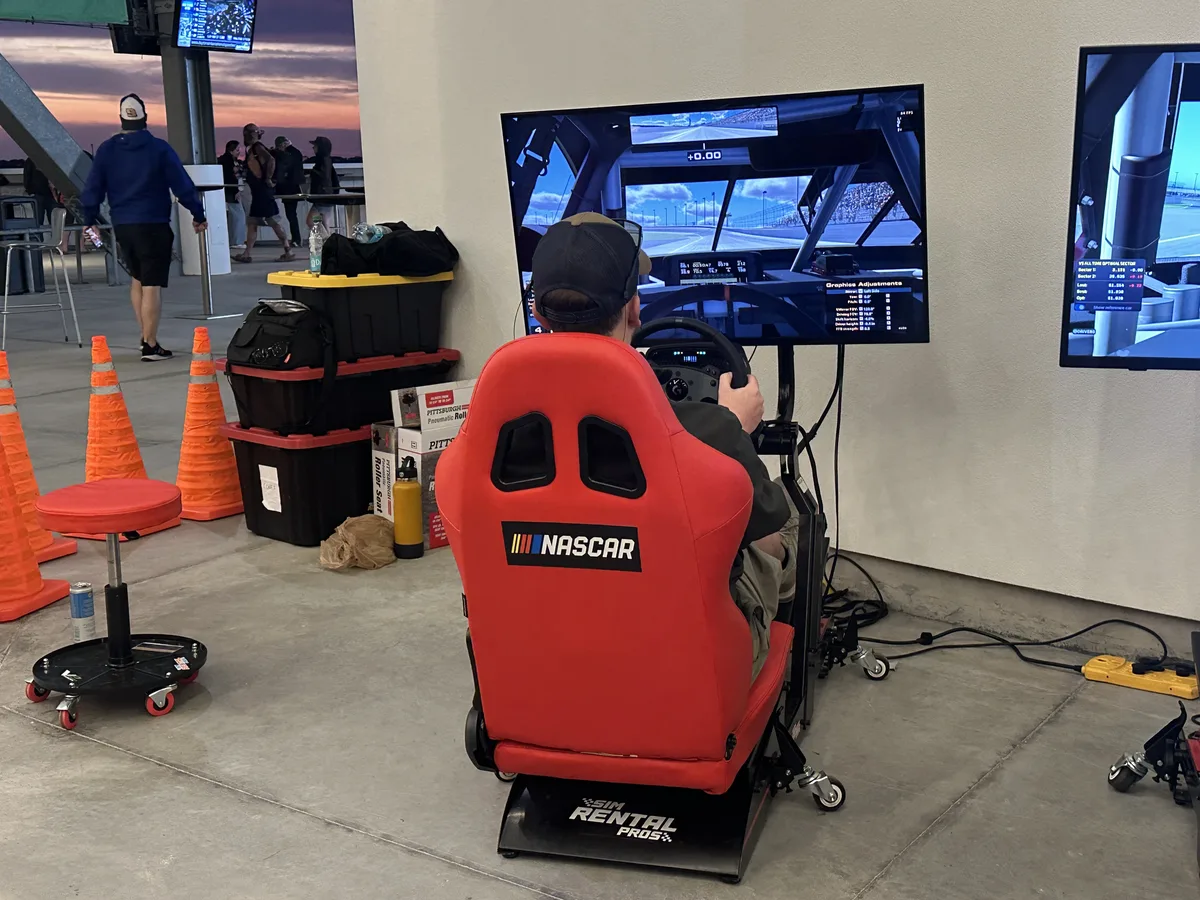
We provide professional, NASCAR-branded racing simulators for trade shows, corporate events, dealerships, and private activations nationwide. Setup, staffing, and lead capture — fully handled.
Get a Free Quote →